

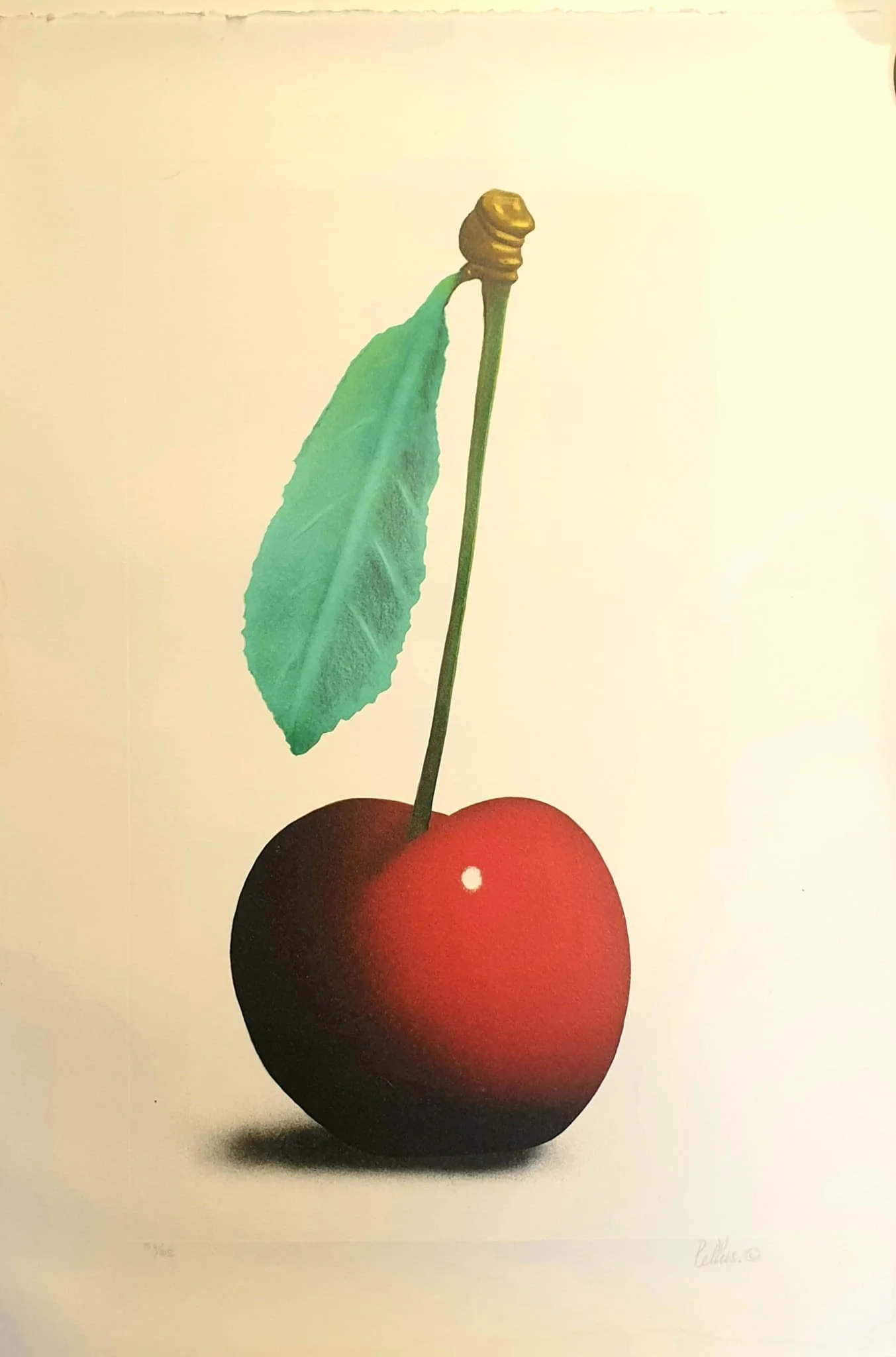
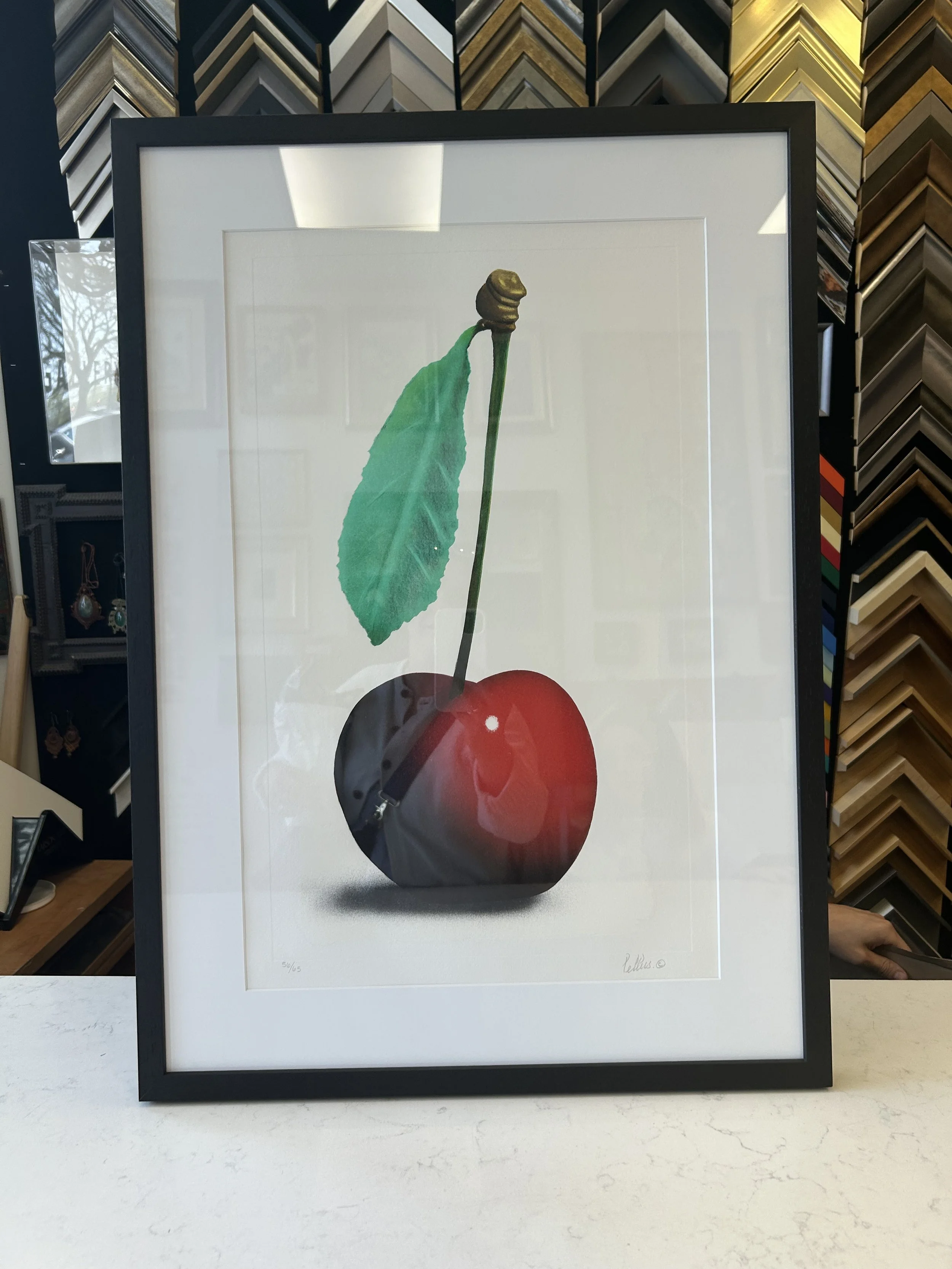
Custom-Framed True Lithograph - “Single Cherry” (17.5” X 25”) By Michel Pellus
Expand your fine art collection with this true Lithograph by Michel Pellus (photo of artwork coming - piece is being custom framed).
About the Artist
With an artistic career spanning more than 40 years, Michel Pellus has a long-established reputation as a realist painter and printmaker. Working almost exclusively in oils, Pellus creates larger-than-life images of contemporary urban culture and fashionable women, with virtuosic technique and a highly modern photographic look.
Born in Montreal in 1945, Pellus descends from a long line of artists originating in Reims, France. His grandfather restored France’s stained glass after the First World War; both his mother and father studied at the École des Beaux-Arts de Montréal before lifelong careers teaching and making art. Pellus is self taught as an artist. In the late 1970s, he lived in New York City’s SoHo before moving to remote Elizabeth Island in the Bahamas. In the late 1980s, he settled in South Florida where he worked and exhibited his work in private galleries until 2018. Michel Pellus’ paintings have been exhibited widely and can be found in many private and public collections, including the Musée d’art Contemporain de Montréal and the Musée National des Beaux-Arts du Québec. His work has been featured in several distinguished design and architectural publications, including Architectural Digest, Florida Design Magazine, and Florida Decor Magazine, where his work has been recognized for its sophistication, visual depth, and enduring appeal within beautifully curated interior spaces. See more work at Pellus.com
About Metal Plate Lithography
In making this edition of lithographs, Pellus prided himself on maintaining the artistry and unique qualities of authentic lithography in an age where mass production has gradually eroded the technique.
Metal plate lithography is a traditional printmaking process based on the principle that oil and water repel one another. In this method, an artist draws directly onto a specially prepared metal plate—most commonly aluminum or zinc—using greasy materials such as lithographic crayons or tusche. The plate is then chemically treated so that the drawn areas attract ink while the non-image areas repel it. When the plate is inked and run through a press, it produces a print that captures a remarkable range of tones, textures, and hand-drawn detail.
Lithography was invented in 1796 by German playwright and printer Alois Senefelder, who originally developed it as a low-cost method of publishing. Over the 19th century, it became an important medium for fine art, illustration, posters, and commercial printing. Artists such as Henri de Toulouse-Lautrec and Pablo Picasso helped elevate lithography into a respected artistic discipline, valued for its immediacy and expressive possibilities. Today, lithography is often considered a dying art because it is labor-intensive, technically demanding, and requires specialized equipment, materials, and studio knowledge that are increasingly rare. Many print shops and art programs have phased it out in favor of digital printing or easier printmaking methods. Unlike mass-produced or digital prints, each lithograph is created through a highly physical, hands-on process that demands both artistry and craftsmanship.
What makes a lithograph different from a “regular print” is that it is not simply a reproduction of an image. A true lithograph is an original print made directly from the artist’s drawing on the plate. Even when printed in an edition, each impression is part of the original artistic process, carrying the subtle variations, texture, and character of the handmade medium. In that sense, lithography sits somewhere between drawing and printing—preserving the artist’s touch in a way few other print processes can.
Frame selected by the artist; this piece is ready to hang.
Donated by Erik & Chiara Pellus Soria and Michel Pellus
Framing Donated by The Art of Framing, Stamford, CT
Value: $1500
Expand your fine art collection with this true Lithograph by Michel Pellus (photo of artwork coming - piece is being custom framed).
About the Artist
With an artistic career spanning more than 40 years, Michel Pellus has a long-established reputation as a realist painter and printmaker. Working almost exclusively in oils, Pellus creates larger-than-life images of contemporary urban culture and fashionable women, with virtuosic technique and a highly modern photographic look.
Born in Montreal in 1945, Pellus descends from a long line of artists originating in Reims, France. His grandfather restored France’s stained glass after the First World War; both his mother and father studied at the École des Beaux-Arts de Montréal before lifelong careers teaching and making art. Pellus is self taught as an artist. In the late 1970s, he lived in New York City’s SoHo before moving to remote Elizabeth Island in the Bahamas. In the late 1980s, he settled in South Florida where he worked and exhibited his work in private galleries until 2018. Michel Pellus’ paintings have been exhibited widely and can be found in many private and public collections, including the Musée d’art Contemporain de Montréal and the Musée National des Beaux-Arts du Québec. His work has been featured in several distinguished design and architectural publications, including Architectural Digest, Florida Design Magazine, and Florida Decor Magazine, where his work has been recognized for its sophistication, visual depth, and enduring appeal within beautifully curated interior spaces. See more work at Pellus.com
About Metal Plate Lithography
In making this edition of lithographs, Pellus prided himself on maintaining the artistry and unique qualities of authentic lithography in an age where mass production has gradually eroded the technique.
Metal plate lithography is a traditional printmaking process based on the principle that oil and water repel one another. In this method, an artist draws directly onto a specially prepared metal plate—most commonly aluminum or zinc—using greasy materials such as lithographic crayons or tusche. The plate is then chemically treated so that the drawn areas attract ink while the non-image areas repel it. When the plate is inked and run through a press, it produces a print that captures a remarkable range of tones, textures, and hand-drawn detail.
Lithography was invented in 1796 by German playwright and printer Alois Senefelder, who originally developed it as a low-cost method of publishing. Over the 19th century, it became an important medium for fine art, illustration, posters, and commercial printing. Artists such as Henri de Toulouse-Lautrec and Pablo Picasso helped elevate lithography into a respected artistic discipline, valued for its immediacy and expressive possibilities. Today, lithography is often considered a dying art because it is labor-intensive, technically demanding, and requires specialized equipment, materials, and studio knowledge that are increasingly rare. Many print shops and art programs have phased it out in favor of digital printing or easier printmaking methods. Unlike mass-produced or digital prints, each lithograph is created through a highly physical, hands-on process that demands both artistry and craftsmanship.
What makes a lithograph different from a “regular print” is that it is not simply a reproduction of an image. A true lithograph is an original print made directly from the artist’s drawing on the plate. Even when printed in an edition, each impression is part of the original artistic process, carrying the subtle variations, texture, and character of the handmade medium. In that sense, lithography sits somewhere between drawing and printing—preserving the artist’s touch in a way few other print processes can.
Frame selected by the artist; this piece is ready to hang.
Donated by Erik & Chiara Pellus Soria and Michel Pellus
Framing Donated by The Art of Framing, Stamford, CT
Value: $1500